What 213 Distilleries Told Us About UK Whisky
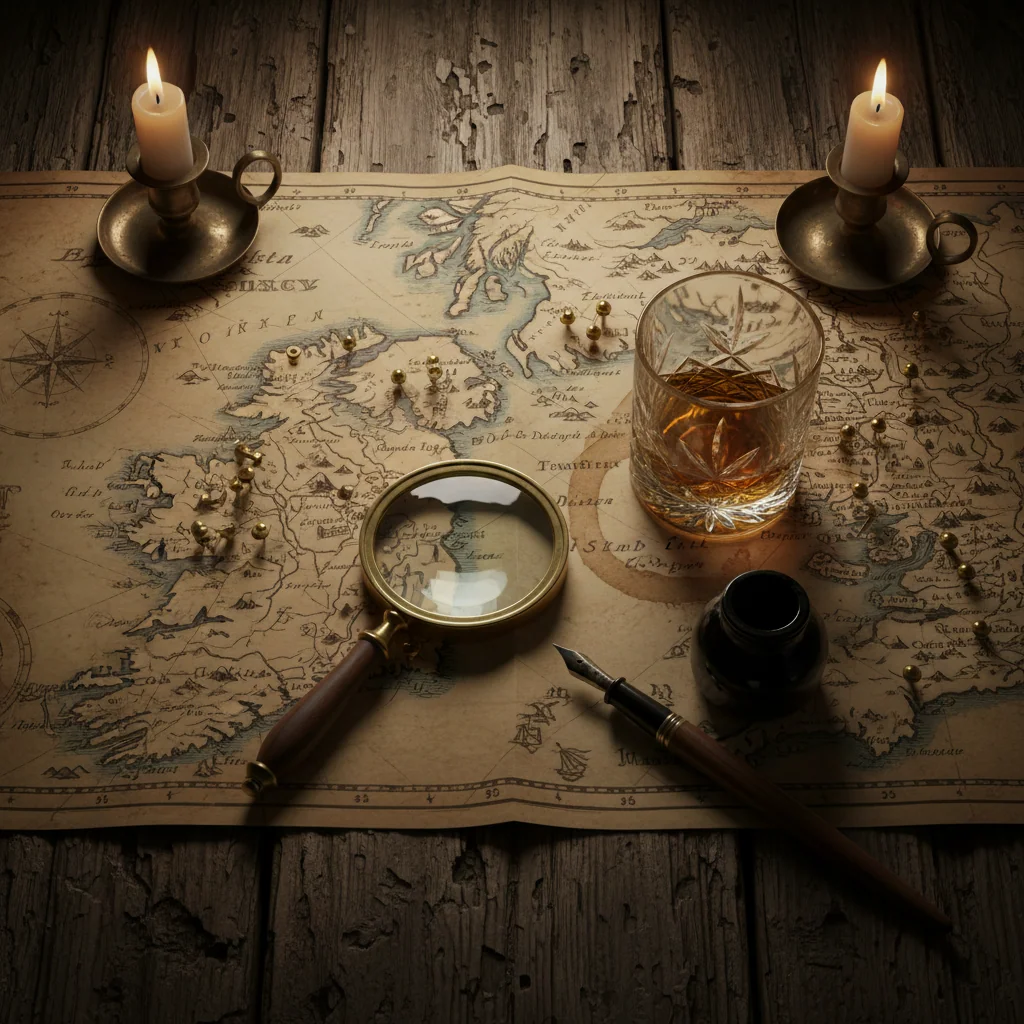
Spread the charts out on the table. Ink still wet, numbers still arguing with each other. Two hundred and thirteen distilleries mapped, catalogued, cross-referenced — a census of copper and oak that stretches from Kirkwall to Kinsale, from Lewis to London. The data tells a story that no single distillery visit could.
We built this database to power our map. But when you sit with 213 records and start asking questions, patterns emerge that change how you think about whisky in these islands. Here is what we found.
The Geography
Five countries, one obsession
Scotland dominates with 143 distilleries in our atlas — 67% of the total here, against the 152 operating Scotch distilleries reported by the Scotch Whisky Association in June 2025. The nine-distillery delta is a coverage gap we're working through (recent openings, gin-led sites still licensed for Scotch, revivals returning to production). Ireland has 30, England 22, Northern Ireland 10, and Wales 8.
What is surprising is how recently the non-Scottish numbers have grown. Twenty years ago, England had a handful of distilleries. Now it has 22, nearly all founded in the last decade. Wales went from one (Penderyn, founded 2000) to eight. Northern Ireland has gone from Old Bushmills standing alone to 10 active operations.
Seventeen regions
We divide the database into 17 regions. Here is the full breakdown:
| Region | Count |
|---|---|
| Speyside | 53 |
| Central Scotland | 26 |
| Scottish Islands | 21 |
| North Scotland | 20 |
| East Scotland | 16 |
| East Ireland | 15 |
| Northern Ireland | 10 |
| West Ireland | 8 |
| North England | 7 |
| South Ireland | 7 |
| West Scotland | 7 |
| South Wales | 6 |
| Midlands | 5 |
| South East England | 4 |
| East England | 3 |
| South West England | 3 |
| North Wales | 2 |
Speyside alone accounts for 53 distilleries — nearly 25% of the total. Add the rest of Scotland's regions and you have 143 distilleries in our coverage of a country with a population of 5.4 million; on the Scotch Whisky Association's 152 figure, that ratio tightens to one operating distillery per roughly 35,500 Scots.
The Timeline
A boom like nothing before
The average founding year across all 213 distilleries is 1942. But that number is misleading — it is dragged forward by the extraordinary recent boom.
Here is the real story: 73 distilleries in our database were founded in 2015 or later. That is 34% of all distilleries, created in just the last eleven years. The whisky industry in these islands is not just old money and heritage — it is a live, accelerating building boom.
Which regions are growing fastest?
If you look at average founding year by region, the pattern is stark:
| Region | Avg Founded | Count |
|---|---|---|
| North Wales | 2019 | 2 |
| West Ireland | 2017 | 8 |
| North England | 2017 | 7 |
| South Wales | 2015 | 6 |
| Midlands | 2014 | 5 |
| East England | 2012 | 3 |
| South West England | 2011 | 3 |
| South Ireland | 2008 | 7 |
| East Ireland | 1997 | 15 |
| Northern Ireland | 1996 | 10 |
Every English and Welsh region has an average founding year after 2010. These are almost entirely new industries. Compare that to Speyside (average 1903) or West Scotland (1902), where the distilling tradition stretches back centuries.
The post-2015 boom has hit hardest in East Ireland (11 new distilleries), Northern Ireland (8), Central Scotland (7), and Scottish Islands (7). Ireland's growth is particularly notable — the country went from a handful of distilleries in 2010 to 30 today.
The oldest and the newest
The oldest entry in our database is Berry Bros. & Rudd, trading since 1698 from 3 St James's Street in London. The oldest active distillery is Kilbeggan in Ireland (1757), followed by The Glenturret in Scotland (1763).
The newest are Ardgowan, Laggan Bay, and Lerwick — all Scottish, all 2025. The building has not stopped.
The Spirits
It is not all whisky
Of 213 distilleries, 171 produce whisky (or whiskey, in Ireland and Northern Ireland) and 40 produce whiskey specifically. But here is where it gets interesting:
- 62 distilleries also make gin — that is 29% of the total
- 21 produce vodka
- 12 make rum
- 7 produce poitin (all in Ireland, where it has protected geographical status)
- 6 make liqueurs
Only 64 distilleries produce more than one spirit type. Penderyn leads the field with five categories (whisky, gin, vodka, rum, and liqueur) across its three Welsh sites.
The gin-to-whisky ratio
Here is a number that tells you about the economics of modern distilling: 62 of 213 distilleries make gin. That is nearly one in three. For new distilleries, the ratio is even higher — gin provides immediate revenue while whisky matures for three or more years. It is not a hobby; it is a business model.
Rum is the emerging story. Twelve distilleries now produce it, concentrated in England and Wales. Expect that number to grow.
The Visitor Economy
Tours and shops
- 166 distilleries offer tours — that is 78% of the total
- 165 have a physical shop on-site
- 140 operate an online shop
Those are striking numbers. Whisky tourism is not a sideline for most distilleries — it is a core revenue stream. The distilleries that do not offer tours tend to be either very large industrial operations (producing malt for blends) or very new and not yet set up for visitors.
The 47 distilleries without tours include workhorses like Allt-A-Bhainne and Auchroisk in Speyside — built purely to feed blending operations — and brand-new projects still laying down their first casks.
What the Data Does Not Show
Numbers tell part of the story. They do not tell you that Abhainn Dearg on the Isle of Lewis is the most westerly distillery in Scotland and runs on a scale that is closer to home-brewing than industrial production. They do not tell you that Ben Nevis at the foot of Scotland's highest mountain has been owned by Nikka of Japan since 1989, or that Ballindalloch is Scotland's only true single-estate distillery, growing barley and maturing whisky on the castle grounds.
The data does not capture the smell of a malting floor at Highland Park, or the view from Ardnamurchan's peninsula, or the controlled chaos of Teeling's tasting room on a Friday afternoon in Dublin.
What 213 distilleries told us is this: the whisky industry in the UK and Ireland is bigger, more diverse, and growing faster than most people realise. Scotland still dominates, but the edges are where the energy is — Wales, Northern Ireland, the English Midlands, the west coast of Ireland. The old guard is not going anywhere. But they have a lot of new neighbours.
A Note on Methodology
Our database includes active distilleries and those in the process of opening. It does not include closed distilleries (except Port Ellen, which has reopened), bonded warehouses, or bottling operations without stills. The 213 count is a snapshot as of March 2026 and will be higher by the time you read this. That is the point.
Continue the voyage
20 Distilleries That Also Make Gin, Rum, or Vodka
64 distilleries in our database make more than just whisky. Here are 20 of the most interesting multi-spirit operations in the UK and Ireland.
The 15 Best Distillery Tours in the UK & Ireland
We ranked the 15 distillery tours actually worth your time across Scotland, England, Wales, and Ireland — from Islay icons to hidden Welsh gems.
Every Islay Distillery Ranked by Peat Level
All 11 Islay distilleries ordered from lightest to heaviest peat, with real PPM levels, tasting notes, and bottles worth trying.