The Map Gap: UK Regions With No Distillery
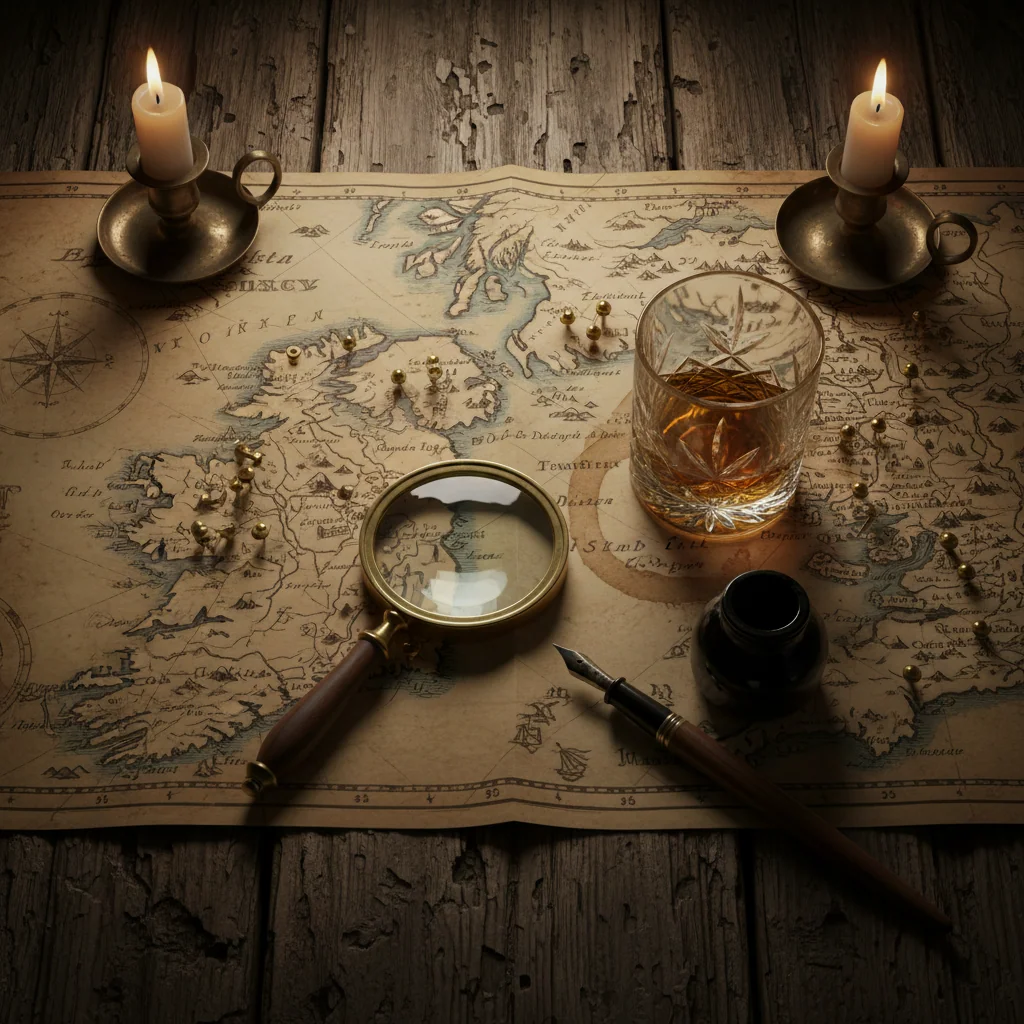
The chart is spread across the table and the gaps speak louder than the pins. Two hundred and thirteen distilleries mapped, and still there are empty stretches of coastline, whole counties, entire regions where nobody has planted a still. The captain's eye is drawn not to the clusters, but to the silence between them.
We built the WhiskeyAtlas map to show where every distillery in the UK and Ireland sits. But staring at 213 pins long enough, the real story becomes obvious: it is not where the distilleries are that is interesting. It is where they are not.
This is a data piece. We took our distillery database — every active, operational distillery we track — and looked for the voids. The counties with zero distilleries. The regions where you could drive for hours without passing a still. And then we asked: why?
The Numbers
Here is how our 213 distilleries break down by country:
| Country | Distilleries | Share |
|---|---|---|
| Scotland | 143 | 67% |
| Ireland | 30 | 14% |
| England | 22 | 10% |
| Northern Ireland | 10 | 5% |
| Wales | 8 | 4% |
Scotland dominates, obviously. But even within Scotland, the concentration is extreme. Speyside alone accounts for 53 distilleries — nearly a quarter of the entire UK and Ireland total — packed into a region roughly the size of Surrey.
Scotland's Gaps
Our atlas catalogues 143 Scottish distilleries; the Scotch Whisky Association's June 2025 industry figures put the operating total at 152, a nine-distillery delta we are still walking through (recent openings, gin-only sites SWA still counts as Scotch-licensed, and a handful of revivals working back into production). Either way, you might assume the country is covered. It is not.
The Central Belt — Glasgow and Edinburgh, home to over half of Scotland's population, have surprisingly few distilleries between them. The Clydeside DistilleryCentral ScotlandToursShop and The Glasgow DistilleryCentral ScotlandToursShop represent Glasgow, while Edinburgh has Holyrood DistilleryCentral ScotlandToursShop and Port of Leith DistilleryCentral ScotlandToursShop. But for two cities of this size, four distilleries is thin. Compare that to the handful of buildings in Dufftown that contain six distilleries within walking distance.
The Borders — historically not whisky country. The Borders DistilleryCentral ScotlandToursShop (The Borders Distillery) opened in Hawick in 2018 and remains essentially alone down there. The Scottish Borders is an area the size of Northumberland with a single whisky distillery. The old Borders distilleries — Kelso, Langholm, Jedburgh — all closed by the mid-1800s and were never replaced.
The Southwest — Dumfries and Galloway is largely empty. Annandale DistilleryCentral ScotlandToursShop and Bladnoch DistilleryCentral ScotlandToursShop hold the flag, but between them and Campbeltown there is a vast stretch of nothing. This is fertile farmland with good water — the raw materials are there. The distilleries simply never came.
England's Desert
England is the real story. Twenty-two distilleries spread across a country of 56 million people. Entire regions are effectively blank.
The West Midlands and Greater Manchester — the most densely populated parts of England outside London, and virtually no whisky distilleries. [spirit-of-manchester] is working on it, but Birmingham, Wolverhampton, Coventry, and the wider West Midlands conurbation — home to nearly 3 million people — has no operational whisky distillery. None.
The East Midlands — Nottingham, Leicester, Derby. Another population cluster, another gap on the map. White Peak DistilleryMidlandsToursShop in the Peak District is the closest thing the region has, but it sits on the western fringe. The flat, fertile agricultural heartland of the East Midlands has the barley and the water but not the distillery tradition.
The North West — Lancashire is empty. Cumbria has The Lakes DistilleryNorth EnglandToursShop, but between the Lake District and Manchester there is a wide corridor of nothing. Liverpool has no whisky distillery. Neither does Preston, Blackburn, or Bolton.
The South and South West — Dartmoor Whisky DistillerySouth West EnglandToursShop and Healeys DistillerySouth West EnglandToursShop represent the far South West, but the stretch from Dorset through Hampshire to Sussex is nearly bare. Copper Rivet DistillerySouth East EnglandToursShop sits in Kent, and Surrey, Berkshire, and Buckinghamshire — the leafy commuter belt — have no operational whisky distilleries at all.
London — a city of 9 million people has exactly two notable whisky-producing operations: Bimber DistillerySouth East EnglandToursShop in Park Royal and East London Liquor CompanySouth East EnglandToursShop in Bow. Bimber in particular has been producing exceptional single malt, proving London can make whisky. But two distilleries for the largest city in Western Europe is still a striking gap.
Wales: Small but Spreading
Wales has 8 distilleries, anchored by the three Penderyn DistillerySouth WalesToursShop sites (Brecon Beacons, Llandudno, Swansea) and Aber Falls DistilleryNorth WalesToursShop in the north. In the Welsh Wind DistilleryWest WalesToursShop and Da Mhile DistilleryWest WalesToursShop fill in the west. But Mid Wales — Powys, the agricultural heart of the country — is essentially empty. And South East Wales, including the Valleys and Newport, has nothing.
For a country actively branding itself around food and drink tourism, Mid Wales feels like an obvious opportunity.
Why the Gaps Exist
The empty spaces on the map are not random. They follow patterns.
Historical momentum. Distilleries cluster where distilleries have always clustered. Speyside had the barley, the water, the peat, and — crucially — the remoteness that made illicit distilling possible before legalisation in 1823. Once an industry establishes itself in a region, suppliers, coopers, transport links, and expertise follow. Starting from scratch somewhere new means building all of that from nothing.
Water. Whisky production requires enormous quantities of clean, soft water. Scotland's granite geology and high rainfall provide this abundantly. The chalk geology of Southern England produces hard water that needs treatment before use. Not a dealbreaker — Bimber uses London water with great success — but it adds cost and complexity.
Planning permission. Distilleries need space, produce noise, and require industrial-grade waste management. Getting planning permission in the English Home Counties or suburban West Midlands is significantly harder than in rural Scotland. Several English distillery projects have reportedly been delayed or abandoned due to planning objections.
Economics. A new whisky distillery needs to wait at least three years (in Scotland, by law) before it can call its spirit whisky. Most wait five to ten years before their whisky is genuinely ready to sell. That means years of capital expenditure before any whisky revenue. In the meantime, most new distilleries survive by making gin — which can be sold immediately. This works in areas with strong tourism or local markets. In a business park in Wolverhampton, less so.
Cultural identity. Scotland is synonymous with whisky. Ireland is getting there again. England is not. When someone opens a distillery in the Highlands, the story writes itself. When someone opens one in Northampton, they spend half their time explaining why.
Where the Next Wave Will Land
Based on current trends, planning applications, and conversations within the industry, here is where the map gaps are most likely to fill:
More English cities. The success of Bimber in London and the Spirit of Manchester project suggests urban distilling is viable. Birmingham, Bristol, and Liverpool feel like the most likely candidates for new city-based whisky distilleries. Bristol in particular has a thriving craft drinks scene that could support one.
The East Midlands. Nottingham or Leicester seem inevitable. The barley supply is right there — East Anglia and Lincolnshire produce some of the best malting barley in the world. The missing piece is someone willing to commit the capital.
South Wales. The success of Penderyn has proven Welsh whisky works commercially. The South Wales valleys have affordable real estate, good water, and a population that would support a distillery visitor centre. Someone will do it.
The Scottish Borders. With The Borders Distillery now operational and their first proper age-statement releases building reputation, it would not be surprising to see a second distillery follow. The Borders has strong tourism infrastructure and is easily accessible from Edinburgh.
A Note on Our Data
Our database tracks 213 distilleries across the UK and Ireland that are either actively producing whisky or have whisky maturing in casks. We do not count distilleries that only produce gin, vodka, or other spirits with no whisky programme. We also do not count closed or demolished distilleries, of which there are hundreds. The map shows where whisky is being made right now — not where it used to be.
What the Map Tells Us
The whisky industry likes to talk about terroir — the idea that place shapes flavour. And there is truth in that. Islay peat, Speyside water, Highland air — these things matter.
But the map tells a different story too. It tells a story about history, economics, and inertia. The reason there are 53 distilleries in Speyside and zero in the West Midlands is not because Speyside water is magical and West Midlands water is not. It is because Speyside had a 200-year head start, and starting from scratch is expensive and slow and requires a particular kind of stubborn optimism.
The good news is that stubborn optimism is clearly not in short supply. England went from essentially zero whisky distilleries in 2000 to 22 in 2026. Wales went from one to eight. The map gaps are filling — slowly, unevenly, but unmistakably.
Twenty years from now, the blank spaces on this map will look very different. The only question is which ones fill first.
Continue the voyage
What 213 Distilleries Told Us About UK Whisky
We analysed every distillery in our database — 213 across 5 countries and 17 regions. Here is what the numbers reveal about the state of British and Irish whisky.
English Whisky: The Lakes, Cotswolds, and London's New Wave
22 English distilleries from Norfolk to the Lake District — a new whisky nation finding its voice outside Scotland's shadow.
The 15 Best Distillery Tours in the UK & Ireland
We ranked the 15 distillery tours actually worth your time across Scotland, England, Wales, and Ireland — from Islay icons to hidden Welsh gems.